

Global Equities: Quality control
U-Wen Kok 19-Mar-2026

In our view, the case for allocating globally has always been rock-solid. The diversification benefits, along with the total return potential of equities from various geographic regions, should be compelling for any investor. Even though home country bias may persist, investors are increasingly revisiting their portfolios and looking for ways to add more exposure to companies domiciled outside the U.S.
We applaud any effort to cast a wider net. But what’s the best approach? We think the current environment favors active equity management and, more specifically, a focus on higher quality, which admittedly underperformed materially in 2025. Nevertheless, we continue to favor quality companies exhibiting attractive cash flows, financial strength, and lower earnings volatility when building our global equity portfolios. In fact, we think quality matters more than ever.
The Opportunity at Hand
We all know that investors have become infatuated with artificial intelligence and its potential. Mega-cap tech stocks and their recent performance have exemplified the love affair with growth and momentum in recent years. Although earnings (for some) have been impressive, it’s reasonable to question whether valuations have become stretched in certain market segments. This compels us to remind investors that quality stocks have tended to outperform over the long term. The chart below illustrates the point:
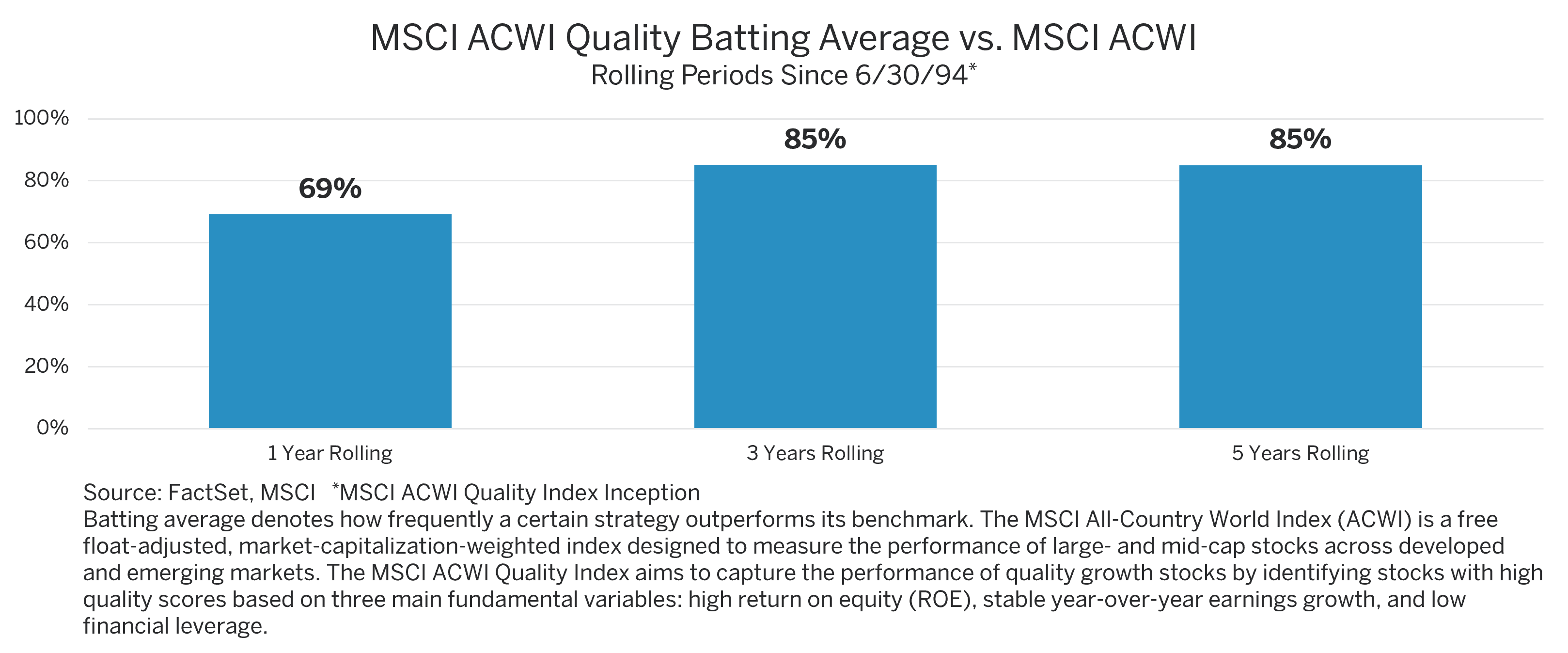
With the emergence of a more speculative market environment, the quality factor has underperformed. In general, the market has not been rewarding those characteristics that we tend to look for in companies, such as profitability, consistency of cash flows and stable earnings, clean balance sheets, and the use of appropriate leverage. Seemingly, the overall need for effective management and smart capital allocation has been discounted by many investors. Compounding matters have been policy uncertainties, particularly with regard to global trade and tariffs. All this has made it harder for quality companies to plan and communicate with investors in a credible way.
We would also be remiss if we did not comment on equity valuations. Given their favorable investment characteristics, we acknowledge that higher-quality stocks might typically command a valuation premium. It’s worth noting, however, that given their recent underperformance, we believe higher quality stocks should now enjoy a more favorable valuation relative to the overall index. Although we never advocate for timing the market, investors would be right to assess whether now is an advantageous time to consider reallocating to quality-oriented global equity strategies.
The Active Advantage?
In allocating to any global equities strategy, we see the current environment as particularly conducive to active management. It’s true that some investors gravitate toward index funds. However, we think investing passively in the global landscape is inefficient at best and downright risky at worst. The irony is that some investors choose passive management for global equities thinking it’s “safe and cheap,” whereas we believe an active approach based on individual company fundamentals is the obvious way to help manage unwanted risk. All investing entails some risk, but we prefer to choose how we allocate it rather than accept the mercurial risks based on index construction.
Risk management is always crucial in this asset class, but perhaps more so than ever given the current market dynamics. In fact, we see elevated volatility that may not be fully measured by looking at the VIX* alone. Rather, in our research, we are finding a larger-than-usual dispersion of stock returns across many global regions. Much of this turbulence is driven by the macro environment, policy uncertainties, and geopolitical landscape, and an active strategy may be able to help account for this dynamic environment.
Assuming the current environment of higher volatility and higher dispersion of returns continues—and we think it will—we believe that an active, quality-oriented approach has a stronger likelihood of capturing alpha (i.e., excess returns versus the benchmark index). And we think there will continue to be intriguing opportunities to acquire quality companies at attractive valuations across regions and sectors thanks to some irrational price movements in recent years (and perhaps in the quarters ahead).
*The VIX is the Chicago Board Options Exchange's Volatility Index, which is a popular measure of market uncertainty and provides market participants a sense of near-term market volatility.