

Fixed Income: Sizing up opportunities in Munis
Allyson Krautheim 12-Oct-2026

Fixed income investors sometimes overlook municipal bonds. After all, munis don’t get much ink, and headline yield numbers don’t always jump off the page. Yet investors sometimes forget to use their tax-equivalent lens when analyzing the true income potential of this fixed income asset class.
Today’s starting yields, which we view as a good driver of long-term returns, appear to offer an attractive entry point. Plus, we see ample opportunities to seek incremental yield, especially for investors who are comfortable allocating to munis with higher credit risk profile.
Our Current Thinking
We remain committed to our core competency of evaluating, taking, and managing credit risk across a broad spectrum of the municipal bond market. Building portfolios bond-by-bond and relying on fundamental credit analysis can be a viable path to capturing potentially higher long-term income, in our view. While we expect there to be some volatility in the muni market in the short term, income-oriented investors with a longer time horizon may be able to withstand it.
Today, we believe municipal bonds represent an attractive investment opportunity, particularly on a relative basis. As of September 21, 2026, the yield-to-worst on the Bloomberg Municipal Bond Index was approximately 4.4% which is a taxable-equivalent yield of 7.4% (in the highest tax bracket of 40.8%). After factoring in the tax-advantaged status offered to municipal bonds, tax-equivalent yields appear to look good relative to the (taxable) Bloomberg U.S. Aggregate Bond Index, which is yielding almost 5.3%.
High Hopes for High Yield
For many investors, high-yield and muni bonds may seem like a contradiction. Yet this is a space that excites us and an area in which we think fundamental analysis thrives. For investors with a higher credit risk tolerance, the higher income segment of muni curve could offer compelling yields with reasonable risk trade-off.
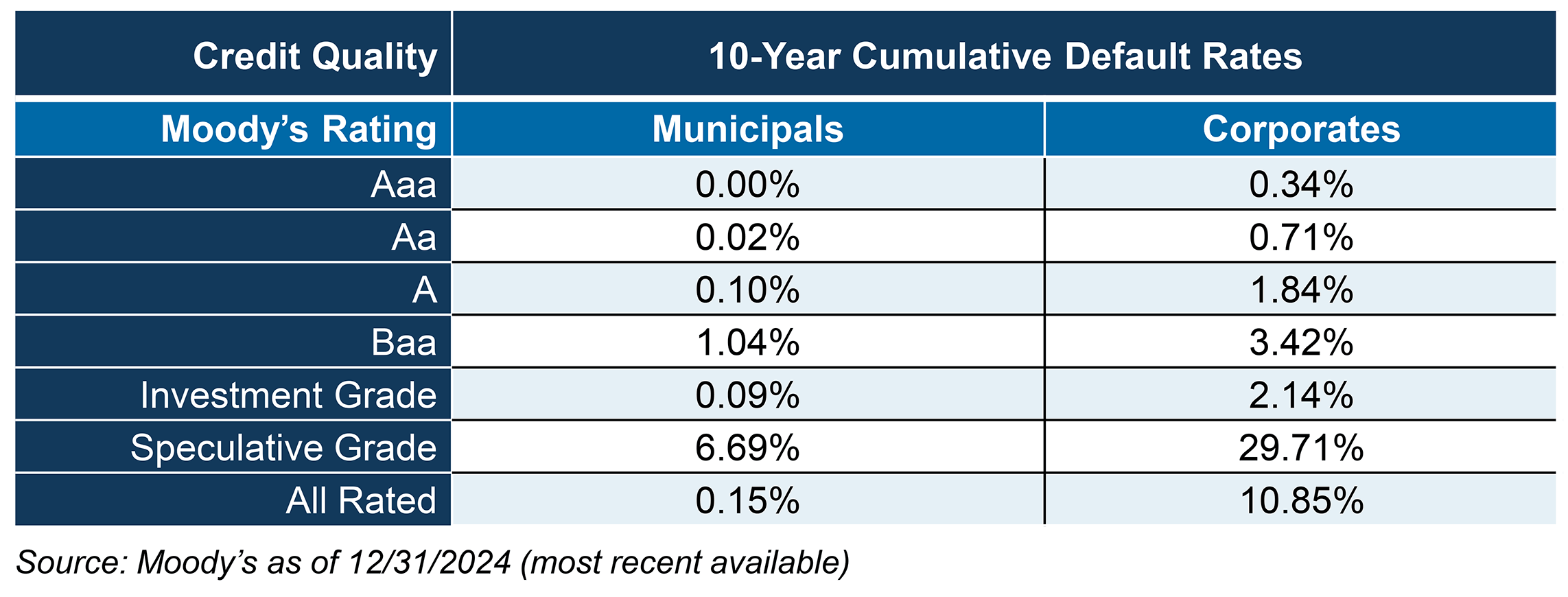
As of September 21, 2026, the yield-to-worst on the Bloomberg Municipal Bond High Yield Index was approximately 5.9%, making the tax equivalent yield approximately 10.0% (for investors in the top tax bracket). That’s meaningful incremental income and higher than many high-yield corporate tax alternatives. As the cumulative default rates averaged over the period of 1970-2024 show in the Moody's chart below, despite the high-yield label, the historical default rates in the muni market have been significantly lower than in the corporate space.
Recent history helps us formulate this view with conviction. As the accompanying table illustrates, 10-year cumulative default rates across all rated munis, including those that are below investment grade, were just 0.15%, as compared to almost 10.9% for corporate debt, as assessed by Moody’s. After adding in our rigorous analysis, we view the high-yield area of the municipal market as attractive. While its historically low default probabilities relative to high-yield corporates do not guarantee the levels of future defaults, we view current fundamentals as strong.
Of course, evaluating and managing credit risk in the higher-yielding segment of the municipal market is of paramount importance, but we believe a bond manager with experience and credit analysis capabilities holds an advantage. The potential yield premium in this space exists precisely because of the complexity associated with some of these bonds, along with the structural inefficiencies in the market. Importantly, a manager with ample scale can also have access to new municipal bond issues that appear to be priced attractively and may not be available to a smaller investor.
In addition, investors who allocate to high yield municipal bonds via an exchange-traded fund (ETF) or mutual fund may enjoy built-in diversification benefits since these funds may own a wide array of securities. This should help manage credit risk and limit the potential impact of a large drawdown due to any single default or distressed situation. We think this is especially important in the higher-yield space.