

Fixed Income: Get in the game
Allyson Krautheim 20-Jul-2026

As a long-time fixed income manager focused on bottom-up fundamental analysis and credit selection, we believe that we can find relative value in many areas of the bond market and in all market environments. That’s what we continually aim to do. And although we are not a “macro” shop, we are not blind to the current economic dynamics that appear to be creating potential tailwinds for fixed income as an asset class. Looking out to the second half of 2026 (and beyond), we believe that bonds remain well positioned on both a relative and absolute basis. Here are three reasons that color our opinion:
- Vanishing Equity Risk Premiums
Equities have historically enjoyed a risk premium over bonds. The equity risk premium can be defined as the difference between the earnings yield on S&P 500 and the “risk-free” yield, represented by the yield on the 10-year Treasury. It illustrates the compensation that investors demand for buying assets deemed riskier (i.e., stocks), compared to those backed by the full faith of the U.S. government (i.e., Treasuries). After all, investors should be compensated more for holding assets that are more volatile and less certain, compared to those that offer rock-solid coupon payments. Looking at the equity risk premium over time provides insight into the relative value of these broad asset classes.
As investors have been piling into stocks (particularly mega-cap growth and AI-themes) the past several years, we’ve seen their capitalizations grow and drive up the value of the S&P 500. But in conjunction with the rising market, we note that the equity risk premium has disappeared and, in fact, turned negative. In other words, the 10-year Treasury yield now exceeds the earnings yield for S&P 500 (as of late June). This implies that investors may not be getting compensated properly to hold onto more volatile equities. The below chart spanning the past two decades illustrates the broader trend.
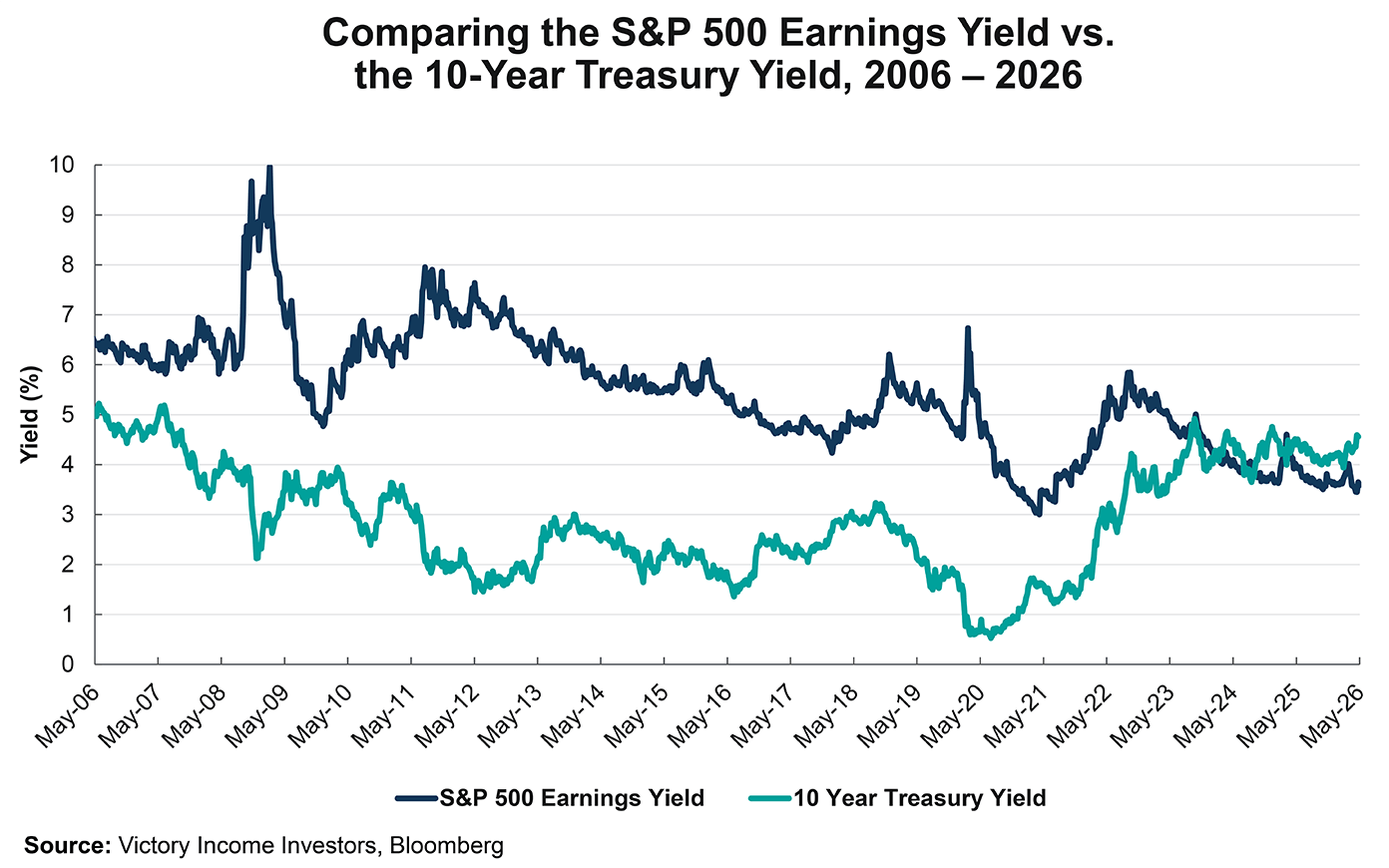
Looking back at the post-Global Financial Crisis period (2008-09), the Federal Reserve moved aggressively to spur the economy by pushing (and keeping) interest rates low. Very low. In effect, investors were being compensated handsomely (some might say motivated) to allocate to equities compared to the repressed yields offered by Treasuries. The risk-premium peaked during the COVID pandemic, which saw low stock prices (and consequently higher earnings yields), as well as very low bond yields. In other words, stocks were attractive versus bonds at that moment.
But what happened next? After the enormous fiscal and monetary stimulus response to the pandemic, inflation surged. The Fed was forced to move aggressively to combat rising prices and pushed yields higher. This flipped the script and made fixed income more attractive relative to equities. Today, we see this dynamic enduring. The external forces shaping the economy may be different now, but the 10-Year Treasury yield hovering close to 4.5% as of late-June 2026, appears to offer a meaningful alternative to richly valued equities. Thus, today’s negative equity risk premiums and tighter credit spreads make a strong case, in our opinion, for allocating new capital to bonds.
- Inflation Compensation
Another way to analyze the risk versus reward tradeoff of bonds is to look at real interest rates. Simply put, the real interest rate earned by bond investors can be thought of as the interest earned minus the rate of inflation. Based on our research dating back two decades, the historical average real yield for the 10-year Treasury note has been near 1%, while today it is roughly double that. Using that lens, it appears that bonds currently offer a credible way to be compensated for inflation risk, something that has not always been the case in the recent era of low yields.
- Starting Rates Matter
Perhaps one of the strongest arguments for allocating new money to bonds is the notion that investors are now being presented with an opportunity to benefit from attractive starting yields. Our experience suggests that fixed income returns are highly correlated to starting yields over a longer time horizon, and for bonds held to maturity, starting yields produce most of the total investment return. That’s why we continue to champion the notion that income drives long-term fixed income returns, and any future increase in rates might be more than offset by a higher income stream over time.
Although we acknowledge that there have been spates of elevated volatility across fixed income markets, we continue to believe that bonds should be a component of most diversified investment portfolios. So for investors worried about volatility in fixed income markets, they should also remember that, generally speaking, bonds tend to mature at par. That means the periodic downside moves in bond pricing are often just a book loss (an accounting loss recorded along the way), so it is not necessarily realized by long-term investors.
Ultimately, we still believe that buying bonds primarily for income and as a counterbalance to offset equity risk are the top reasons for investing in them. This might provide some solace for any investor currently worried about things like economic growth, geopolitics, a new Fed Chair, or equities valuations. Stepping back to view the big picture, we cannot help but see potential tailwinds for the fixed income asset class.