

Equities: Surviving the roller coaster
WestEnd Advisors Investment Team 10-Jun-2026

Equity investors could be forgiven for feeling whiplashed. Sentiment has been pinballing back and forth this year, and quite dramatically at times. Geopolitical turmoil in the Middle East and a subsequent energy price spike have been primary culprits, but a host of other uncertainties, including the outlook for interest rates, inflation, employment and economic growth are also contributing to the heightened market volatility.
This risk-on/risk-off roller coaster can take an emotional toll on investors, making it hard to stay the course with passive or traditional bottom-up active portfolios. In this environment, many investors may be searching for differentiated and potentially more durable strategies for their core equities allocation.
We believe our macroeconomically-driven, top-down investment approach offers such an alternative by allocating dynamically to sectors that we expect to benefit from economic tailwinds and avoiding those sectors facing headwinds. Seeing a portfolio tilted toward economically cyclical areas of the market when the economic outlook is strong, and seeing more defensive positioning as the outlook wanes, may give investors more confidence to stay invested. In turn, this should increase their ability to capture the long-term returns they may need to reach their goals.
Staying Calm and Confident
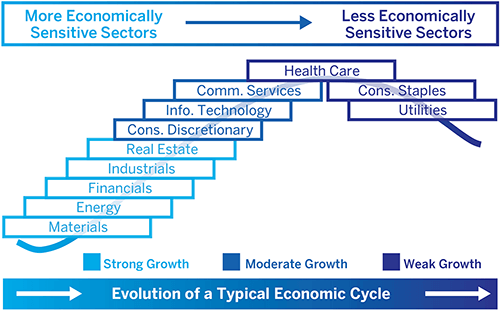
The economic cycle—that natural oscillation between times of expansion and contraction—follows a general pattern and tends to exhibit certain repeated characteristics from cycle to cycle. We believe intensive qualitative analysis of the macroeconomic landscape can identify areas of potential strength and weakness in the economy, and by extension, equity markets. Portfolio positioning does not need to be passive or static, but rather it should evolve along the economic cycle.
In fact, looking back over more than three decades, our research of sector performance within the S&P 500® Index highlights significant dispersion of returns between the top performing and worst-performing sectors at any given time. In our view, this varied sector performance offers greater opportunity for outperformance through active allocation as opposed to building portfolios based on style or market capitalization-based allocation. In other words, we view analysis of macroeconomic data to drive dynamic sector allocation and avoidance as a way to take advantage of a persistent market opportunity.
We believe this type of actively managed approach provides a sound basis from which to build a core domestic equity portfolio with the ability to capture excess returns versus a benchmark over longer time horizons, regardless of where we are in the economic cycle. We also think that the active sector avoidance is an advantage when it comes to risk management and should help avoid some of the steepest drawdowns in times of market tumult. And finally, this type of approach might even allow investors to simplify their broader approach to equity portfolio construction by allowing them to reduce reliance on multiple sub-asset classes and specific styles.
Translating Into Portfolio Positions
So how does WestEnd Advisors view the current economic backdrop as we approach the halfway point of 2026, and how might that translate into portfolio positioning?
From our perspective, we still see U.S. profit growth as a primary market driver, which could help deliver positive returns for the year despite the wide fluctuations in valuations and multiples. While the Middle East conflict has driven some volatility, the key question for our broader macro and market outlook is how much longer oil supply and other disruptions persist. For now, financial markets still appear largely to be looking past the conflict.
Assuming impacts from the Iran conflict remain relatively limited in magnitude and duration, the current late-cycle economic backdrop can persist, in our view. So, while uncertainty and volatility endure, we believe a balance of defensive and select economically sensitive exposures may help portfolios weather near-term volatility and still capture potential opportunities as geopolitical
uncertainties eventually ease.
Meanwhile, in our large-cap equity allocations, we are avoiding several of the most cyclical early-phase sectors, but we maintain a significant mid-phase allocation, including Information Technology exposure and an overweight of Communication Services, which provides exposure to positive secular trends, in our view.
An All-Weather Strategy?
Simply put, we actively seek to align portfolios with the macroeconomic backdrop throughout the economic cycle. For advisors and their clients, implementing WestEnd’s active management might be as close to a set-it-and-forget-it strategy as there is. After all, dynamically reallocating in step with the economic cycle should give investors the confidence to stay the course in uncertain times.
This report should not be relied upon as investment advice or recommendations and is not intended to predict the performance of any investment. The information contained herein is not intended to be an offer to provide investment advisory services. Such an offer may only be made if accompanied by WestEnd Advisors’ SEC Form ADV Part 2. These opinions may change at any time without prior notice. All investments carry a certain degree of risk including the possible loss of principal, and an investment should be made with an understanding of the risks involved with owning a particular security or asset class. Portfolio characteristics and/or allocations are generally averages and are for illustrative purposes only and do not reflect the investments of an actual portfolio unless otherwise noted. Portfolios that are concentrated in a specific sector or industry may be subject to a higher degree of market risk than a portfolio whose investments are more diversified. While every effort has been made to verify the information contained herein, we make no representation as to its accuracy.