

Equities: The flip side of the (AI) coin
Robert Harris 09-Jan-2026

Investors' love affair with all things AI-related knows no bounds. Occasionally we get whiffs of valuation concerns, and this cohort of stocks sells off in a condensed period of heightened volatility. But then investors come roaring back—at least they have so far.
There is no doubt that AI has been one of the key catalysts that drove equity markets higher in 2025. But there’s a flip side to such a narrow focus on hyperscalers and AI themes. On one hand we see elevated concentration risk that is either overlooked or excused. On the other hand, we also see intriguing investment opportunities in stocks that are being largely ignored. What an interesting dynamic for stock pickers in 2026!
One Picture Tells the Story
Everyone wants to cash in on the AI story, and for good reason. Artificial Intelligence is a transformative technology that is reshaping society and has ramifications for all businesses. We certainly don’t disagree on its far-reaching impact. But the legions of capital chasing AI memes might also be a cautionary tale. Is history repeating, or possibly rhyming? Remember, the emergence of the Internet was certainly a seismic shift, but not all dot-com stocks—even those that benefited from first-mover status and powerful capital backing—enjoyed lasting success. We see parallels.
In today’s equity market, our collective fascination with AI has created an unusual backdrop whereby high-beta stocks—loosely defined as those that are more volatile than the overall market—have been significantly outperforming the broader market and low-beta stocks. This dynamic has occurred in the past, often in strong bull markets, in anticipation of lower interest rates, or in other periods where investors become enamored by story-stocks and their potential. However, it has recently grown to extremes, as illustrated in the below graph.
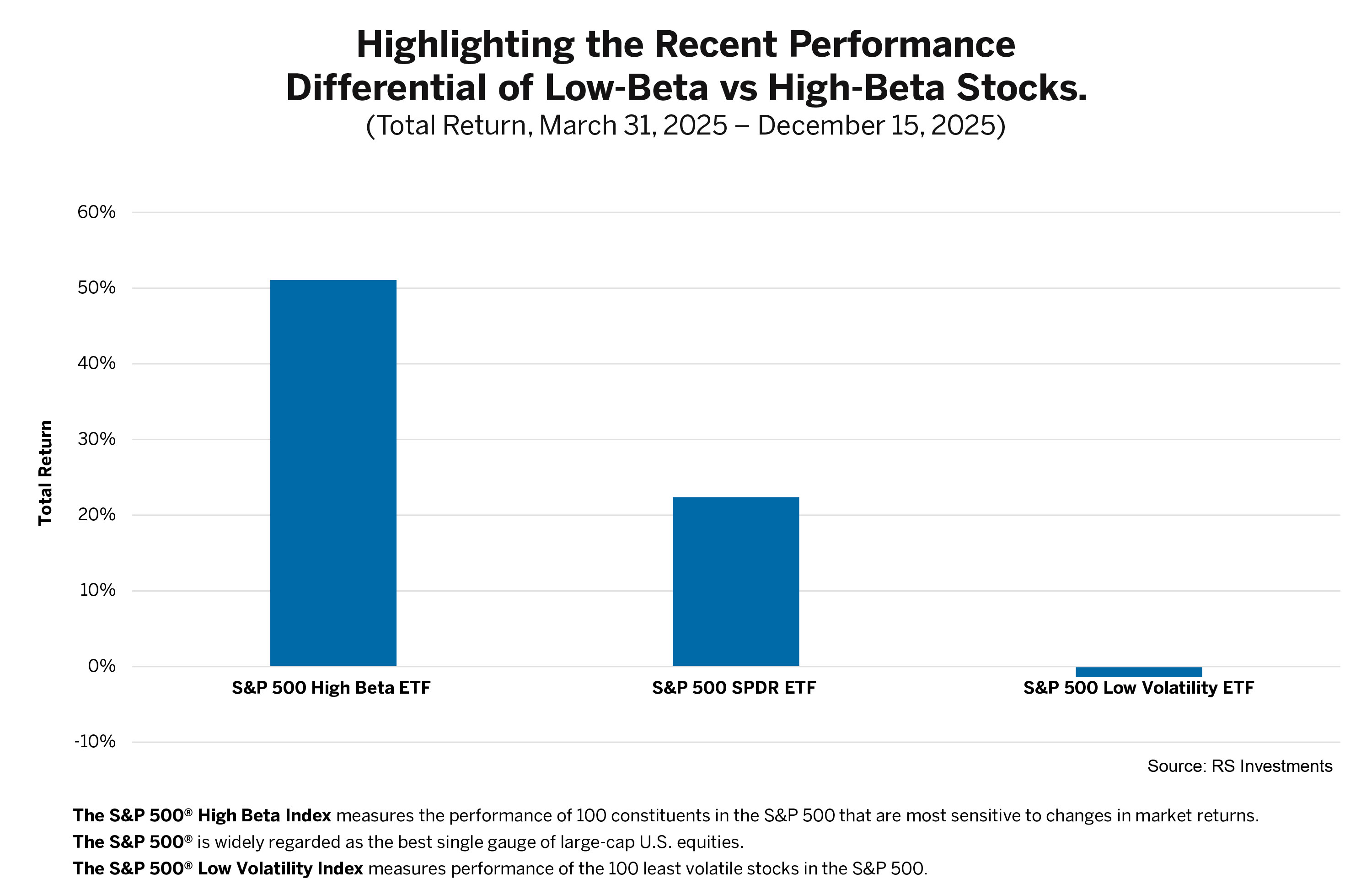
As we look out to 2026, we believe that investors—particularly those favoring passive, large-cap domestic strategies—are taking on substantial concentration risk. If the momentum for AI companies wanes, or if a few tech giants stumble on their earnings promise, the major market indexes could be dragged lower quickly. Meanwhile, many companies are being left behind despite improving cash flows and fundamentals. In fact, we see many high-quality companies that have seen their multiples contract this year for no other reason than the fact that they don’t provide direct exposure to the area that the market presently adores.
Finding Value within Value
Despite it all, we maintain that this is an exciting time to be a value-oriented investor, and we believe there are a growing number of companies with improving return stories that are now trading at deep discounts to their intrinsic value. We certainly won’t be changing our stripes to chase AI story stocks any time soon. Rather, we are adhering to our valuation principles and are perfectly content to acquire stocks closer to our downside price target. This seems especially prudent at a time when the broad market is richly valued, potentially making the major market indexes (and any passive strategies that track those benchmarks) vulnerable from the current high concentration risk.
In building our value-oriented portfolios, we prefer to focus on a company’s balance sheet and cash flows to better understand the potential for financial improvement (or conversely to look for any signs of financial decay). The one metric that we believe is most useful in determining future stock performance is Return on Invested Capital (ROIC)—and more specifically—anticipated changes in forward-looking ROIC.
This helps us identify businesses undergoing important structural improvements, which are often accompanied by new leadership, changes in the competitive landscape, the uncovering of underappreciated assets, or other circumstances that can lead to significant gains in a company’s ROIC.
We believe that targeting and acquiring companies with improving ROIC is a path to building an attractive value-oriented portfolio. Importantly, companies on the cusp of these ROIC inflection points may be able to improve financial performance irrespective of what is happening in the general economy. We also think this value-oriented approach provides a layer of insulation if the momentum for AI stocks wanes or reverses. After all, investors chasing high growth potential can be fickle. We’ve seen it before, and it’s one of the reasons we prefer a value-oriented approach.